Why Every Business Needs a Website in 2026 (And Social Media Is Not Enough)

Let me ask you something.

When was the last time you wanted to try a new restaurant, hire a plumber, or buy something from a local shop and you didn’t Google it first?

Exactly.

We all do it. Before we spend our money, before we trust anyone with our time we search online. And if a business doesn’t show up in search results? Most of us quietly move on to the one that does.

That’s the reality of doing business in 2026. Your customer is already online. The only question is: are you there when they search for you?

The Truth About Social Media That Business Owners Ignore

“But I already have a Facebook page”

I hear this every single week. And I understand Facebook, Instagram, and TikTok feel like enough. They’re free, they’re easy, and your customers are there.

But here’s the problem most small business owners don’t realize until it’s too late:

You do not own your Facebook page. Facebook does.

The algorithm can change overnight. Your reach can drop to near zero without warning. Your account can be suspended for reasons you never even understand. And just like that your entire online presence is gone.

Your website, on the other hand, belongs to you. It lives on your domain. No platform owns it. No algorithm controls who sees it. When every other business needs a website to survive, a Facebook page simply isn’t a substitute.

Why Every Business Needs a Website: 6 Real Reasons

1. Your Website Is Your 24/7 Salesperson

Your shop closes at night. Your team logs off. You put your phone down.

But your website is open 24 hours a day, 7 days a week. It answers questions, shows your work, collects inquiries, and builds trust without you lifting a finger.

For a small business, that kind of constant availability is a serious competitive advantage.

2. First Impressions Now Happen Online Not in Person

When someone hears about your business for the first time, what’s the very next thing they do?

They search for you.

A professional website immediately communicates: “I am serious about my business. You can trust me.”

No website or worse, just an outdated social media page sends the opposite signal. People judge fast. Your website is your first handshake with customers you’ve never met.

3. Google Will Send You Free Customers If You Have a Website

Facebook shows your content only to people who already follow you, or to people you paid to reach.

Google is completely different. Google shows your business to people actively searching for exactly what you offer in your city, your country, or anywhere in the world.

A small business in Sylhet with a well-optimized website can attract clients from Dhaka, Chittagong, or even internationally. A designer with a strong portfolio site can land clients on Fiverr without cold-messaging a single person.

That is the power of being searchable. And to be searchable on Google, you need a website.

4. A Website Builds Credibility That Social Media Cannot

Stanford research has shown that 75% of people judge a company’s credibility based on its website design. Customers are looking for proof that you’re legitimate before they spend their money.

A website gives you space to show:

  • Client testimonials and reviews
  • Your portfolio or past work
  • Your story, values, and expertise
  • Certifications and credentials

A Facebook page can show some of this. A proper website does it in a way that builds real trust.

5. A Website Makes All Your Other Marketing Work Better

Here’s something every marketer knows: every other promotional effort you make social media posts, printed flyers, word-of-mouth referrals, paid ads performs better when you have a website backing it up.

“Check out my portfolio at alaminalamin.com” is infinitely more powerful than “Search for me on Facebook and hopefully find my page.”

Your website is the home base. Everything else simply drives traffic there.

6. Your Competitors Already Have One

This is uncomfortable, but it’s true.

Your competitor down the road has a website. Maybe it’s basic. Maybe it’s not even that good. But it exists.

And when a customer searches for the service you both offer, Google finds them not you.

A simple, clean, professional website with just 4 or 5 pages is enough to completely change how people perceive your business. You don’t need anything fancy. You just need to show up.

The Bigger Question You Should Be Asking

The question isn’t “Do I need a website?”

The real question is: how many potential customers have already searched for your service this week and went to a competitor because you weren’t there?

Because they’re out there right now. Searching. And if you’re not there, someone else gets that customer, that sale, and that relationship.

A professional website is no longer a luxury for established businesses. It is the minimum expectation for any business that wants to be taken seriously in 2026 whether you’re a business owner, a local shop, or a growing brand.

Start With a Brand That Stops People in Their Tracks

Every great website starts with one thing: a strong brand identity.

A recognizable logo. A consistent color palette. A visual language that tells your story before a single word is read.

That’s exactly what I help businesses build.

Whether you’re starting from zero or refreshing an old look, I create brand identities that make businesses look professional, trustworthy, and unforgettable on their website and everywhere else.

Frequently Asked Questions

Does every small business really need a website? Yes. Regardless of size or industry, a website gives your business credibility, searchability on Google, and a permanent online presence you fully own.

Is a Facebook page enough instead of a website? No. Social media platforms control your reach and can remove your account at any time. A website is an asset you own permanently.

How many pages does a business website need? Even 4–5 pages (Home, About, Services, Portfolio, Contact) is enough to make a professional impression and rank on Google.

What should a business website include? At minimum: a clear description of your services, contact information, customer testimonials, and examples of your past work or portfolio.

Link “logo design” Link “brand identityOur facebook page

Web Development Services | That Actually Grow Your Business

Web Development Services

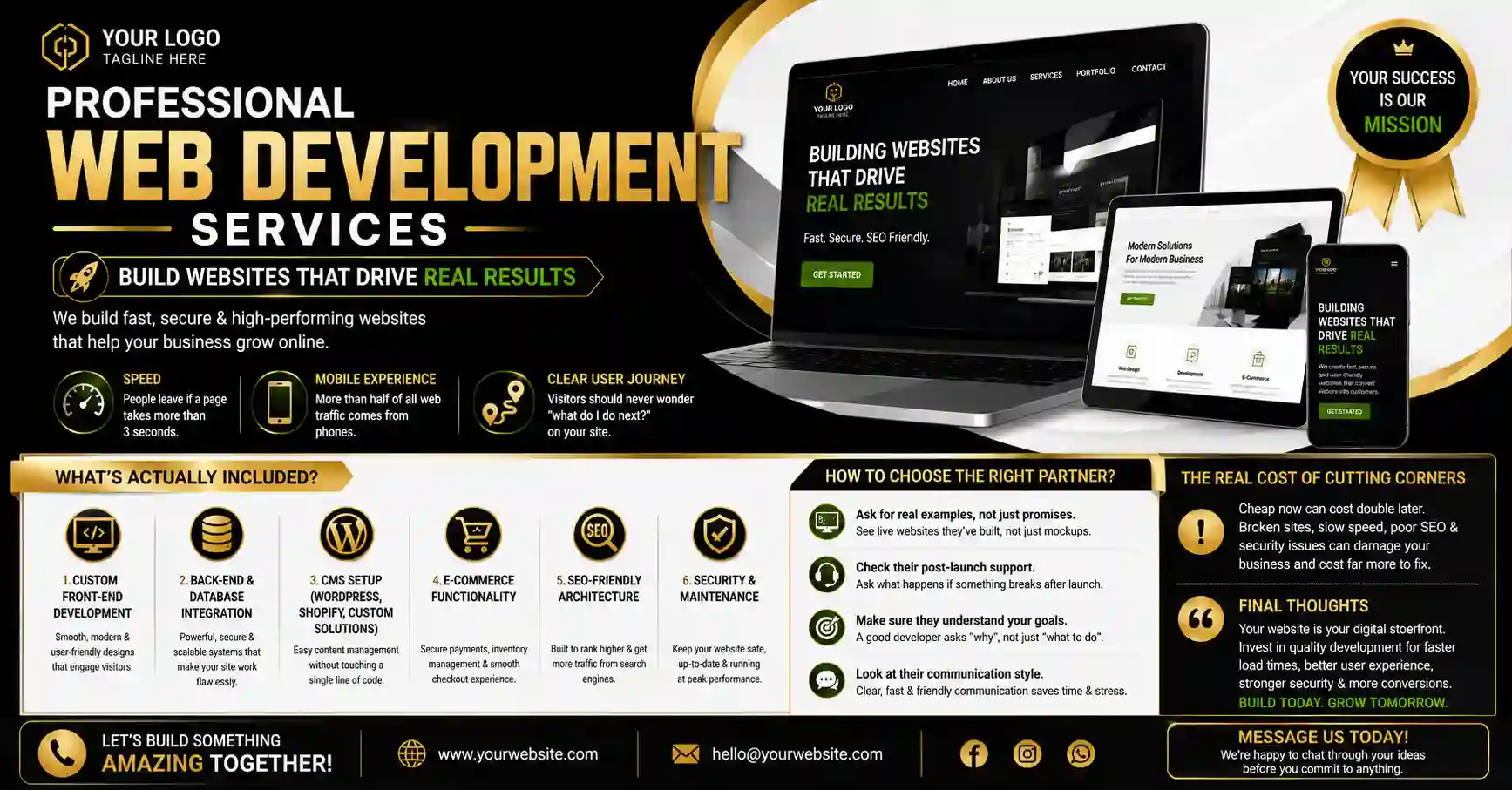
Let’s be honest—your website is often the very first impression people get of your business. Before someone calls you, visits your store, or sends an email, they Google you. And what they find in those first three seconds decides whether they trust you or click away to a competitor instead.

That’s exactly why choosing the right web development services isn’t just a “nice to have” anymore. It’s the backbone of how modern businesses survive, compete, and grow online.

In this article, I’ll walk you through what good web development really means today, why so many businesses get it wrong, and how to pick a team that won’t just build you a website—but build you a digital asset that actually works for your business.

Website design and development

Why Web Development Services Matter More Than Ever

A lot of business owners still think of a website as a digital business card—something you put up once and forget about. That mindset is outdated, and honestly, it’s costing businesses real money.

Here’s the truth: your website is a 24/7 salesperson. It works while you sleep, answers questions before customers even ask them, and either builds trust or destroys it within seconds. A slow, outdated, or confusing website pushes people straight into your competitor’s hands.

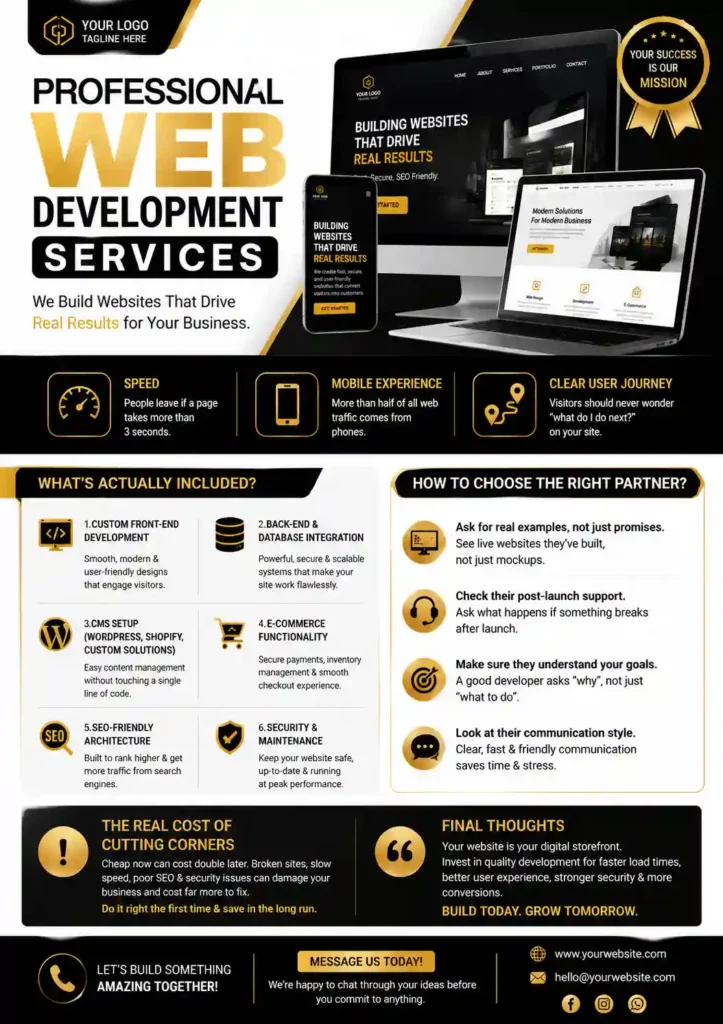
Good web development services solve this by focusing on three things that actually matter:

  • Speed – People leave if a page takes more than 3 seconds to load. No exceptions.
  • Mobile experience – More than half of all web traffic comes from phones. If your site isn’t built mobile-first, you’re losing customers daily.
  • Clear user journey – Visitors should never wonder “what do I do next?” on your site.

When these three pillars are handled properly, your website stops being a static page and starts becoming a real growth engine.

Web Development Services: What’s Actually Included

This is where a lot of confusion happens. People hear “web development” and assume it just means “making a website look nice.” But that’s only design. Development is the engine underneath the hood—the part that makes everything actually function smoothly.

A complete web development service typically covers:

1. Custom Front-End Development
This is everything the user sees and interacts with—buttons, menus, animations, layouts. It needs to feel smooth and intuitive, not clunky or confusing.

2. Back-End & Database Integration
This is the invisible part that makes your site actually work—storing data, processing forms, managing logins, handling payments. Without solid back-end work, even a beautiful website breaks down fast.

3. CMS Setup (WordPress, Shopify, Custom Solutions)
Most businesses need to update content themselves—new blog posts, new products, new offers. A good developer sets up a system that lets you do this without touching a single line of code.

4. E-commerce Functionality
If you’re selling products or services online, this includes secure payment gateways, inventory management, and a checkout process that doesn’t scare customers away halfway through.

5. SEO-Friendly Architecture
This is huge and often overlooked. A site can look stunning but be invisible on Google because of poor technical structure. Proper URL structures, fast loading speed, clean code, and mobile responsiveness all directly affect your search rankings. If you want to understand how this connects with content strategy, check out our guide on SEO best practices for a deeper breakdown.

6. Security & Maintenance
Hacked websites, broken links, expired SSL certificates—these aren’t rare problems. They happen constantly to neglected sites. Ongoing maintenance keeps your business protected and your visitors safe.

How to Choose the Right Web Development Partner

Not all developers are created equal, and price alone shouldn’t be your deciding factor (a cheap website that breaks in six months isn’t actually cheap).

Here’s what to actually look for:

Ask for real examples, not just promises. Any decent agency or freelancer should be able to show you live websites they’ve built—not just mockups or screenshots.

Check their post-launch support. Websites aren’t “set and forget.” Ask directly: what happens if something breaks two months after launch? If the answer is vague, that’s a red flag.

Make sure they understand your business goals. A good developer doesn’t just take instructions—they ask why. Why do you want a contact form there? Why this color scheme? What’s the actual goal of this page? If they’re not asking these questions, they’re just executing tasks, not building a strategy.

Look at their communication style. You’ll be working closely with this person or team for weeks, sometimes months. If communication feels slow or confusing now, it won’t magically improve after you’ve signed the contract.

If you’re still comparing options, our website development pricing guide breaks down what you should realistically expect to pay based on project complexity.

The Real Cost of Cutting Corners

I’ve seen this story play out too many times: a business goes with the cheapest option to “save money,” and six months later they’re paying double to fix what was done wrong the first time—broken mobile layouts, security vulnerabilities, slow load times that tank their SEO rankings.

Web development is one of those areas where doing it right the first time genuinely saves you money long-term. Think of it like building a house. You can cut corners on the foundation, sure—but eventually, cracks show up, and fixing them later costs far more than building it properly from day one.

Final Thoughts

Your website isn’t just a digital brochure anymore—it’s often the deciding factor between a customer choosing you or your competitor. Investing in proper web development services means investing in faster load times, better user experience, stronger security, and ultimately, more conversions.

Whether you’re starting from scratch or rebuilding an outdated site, focus on finding a development partner who treats your website as a long-term business asset—not just a one-time project to finish and forget.

Got questions, or want to see examples of real projects? Feel free to message us directly on our Facebook page—we’re always happy to chat through ideas before you commit to anything.

What Is Web Development? A Complete Beginner’s Guide

What Is Web Development? A Complete Beginner's Guide

Have you ever wondered how the website you’re reading right now actually came to life? Behind every button you click, every form you fill out, and every page that loads smoothly, there’s a process working quietly in the background. That process is called web development, and it touches almost every part of our digital lives today.

Whether you’re a student exploring career options, a business owner planning to launch your first website, or simply someone curious about how the internet works, understanding web development can open up a whole new world. In this article, we’ll break down exactly what web development means, how it works, and why it matters more than ever in 2026.

Website design and development

What Is Web Development

So, what is web development exactly? In simple terms, web development is the process of building, creating, and maintaining websites or web applications that run on the internet or an intranet. It covers everything from writing the code that makes a webpage function to designing how that page looks and feels to the people using it.

Web development is not just one single skill. It’s actually a combination of different tasks working together, including:

  • Writing the structure of a webpage (using HTML)
  • Styling that structure to make it visually appealing (using CSS)
  • Adding interactivity and dynamic behavior (using JavaScript)
  • Managing the server, database, and backend logic that powers the website
  • Testing, debugging, and maintaining the site after it goes live

Think of it like building a house. The structure is the foundation and walls, the styling is the paint and furniture, and the interactivity is the electricity and plumbing that make the house actually livable. Without all three working together, you don’t have a functional website—you just have pieces.

Today, web development has evolved far beyond simple static pages. Modern websites are interactive, responsive, fast, and often powered by intelligent systems behind the scenes. If you want to go deeper into the technical side of how websites are built, you can check out our detailed guide on front-end vs back-end development to understand the two major sides of this field.

Why Web Development Matters in Today’s Digital World

You might be thinking, “Okay, but why should I care about this?” The truth is, web development matters because almost every business, brand, and service today relies on having a strong online presence. A well-built website isn’t just a nice-to-have anymore—it’s often the first impression a customer gets of a company.

Here’s why web development has become such a valuable and in-demand skill:

1. Businesses need websites to survive and grow. Whether it’s an online store, a portfolio, or a service-based business, having a functional website helps build trust and credibility with customers.

2. User experience directly affects success. A slow, confusing, or broken website drives visitors away within seconds. Good web development ensures pages load quickly and work smoothly across all devices.

3. The industry is growing rapidly. The web development field continues to expand year after year, with new tools, frameworks, and approaches emerging constantly. Developer roles remain in strong demand globally, and companies keep investing in better digital experiences.

4. Technology keeps evolving. Modern web development now involves smarter frameworks, faster loading techniques, and AI-assisted coding tools that help developers build applications more efficiently than ever before. Staying updated with these changes is essential for anyone working in this space.

5. It opens career opportunities. From front-end developers to full-stack engineers, the demand for skilled web developers continues to rise across industries—tech, healthcare, education, e-commerce, and beyond.

If you’re just starting your journey, it helps to understand the difference between the two main types of development work involved. You can explore our beginner-friendly breakdown of HTML, CSS, and JavaScript basics to get a clearer picture of where to start learning.

Final Thoughts

To sum it up, web development is the art and science of building the websites and applications we use every single day. It blends technical coding skills with creative design thinking to create something functional, accessible, and engaging for users.

Whether you’re planning to learn web development yourself or simply hire someone to build your website, understanding the basics gives you a strong foundation to make better decisions. The web is constantly evolving, and those who understand how it works will always have an advantage—whether that’s growing a business, building a career, or simply satisfying personal curiosity.

If you found this guide helpful and want more easy-to-understand tech content like this, feel free to follow our page for regular updates: Visit Our Facebook Page

We regularly share tips, tutorials, and the latest trends to help you stay ahead in the digital world.